Investigating the role of Annexin A7 in axonal mitochondrial dynamics
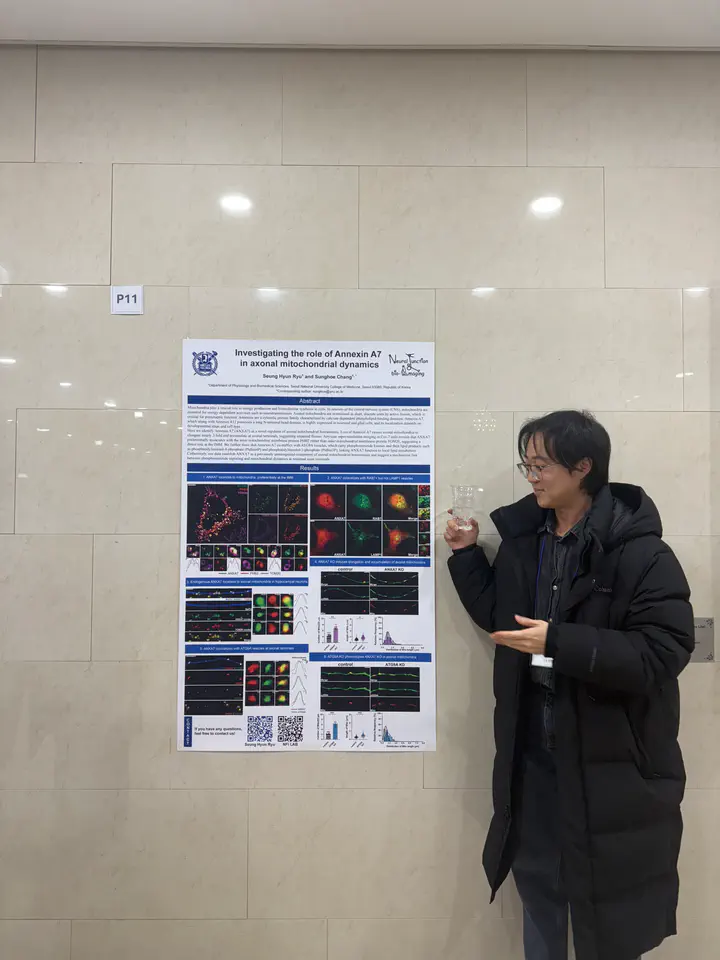 Image credit: Seung Hyun Ryu
Abstract
Mitochondria play a crucial role in energy production and biomolecular synthesis in cells. In neurons of the central nervous system (CNS), mitochondria are essential for energy-dependent activities such as neurotransmission. Axonal mitochondria are maintained as short, discrete units by active fission, which is critical for presynaptic function. Annexins are a cytosolic protein family characterized by calcium-dependent phospholipid-binding domains. Annexin A7, which along with Annexin A11 possesses a long N-terminal head domain, is highly expressed in neuronal and glial cells, and its localization depends on developmental stage and cell type. Here we identify Annexin A7 (ANXA7) as a novel regulator of axonal mitochondrial homeostasis. Loss of Annexin A7 causes axonal mitochondria to elongate nearly 2-fold and accumulate at axonal terminals, suggesting impaired fission. Airyscan super-resolution imaging in Cos-7 cells reveals that ANXA7 preferentially associates with the inner mitochondrial membrane protein PHB2 rather than outer mitochondrial membrane protein TOM20, suggesting a direct role at the IMM. We further show that Annexin A7 co-traffics with ATG9A vesicles, which carry phosphoinositide kinases and their lipid products such as phosphatidylinositol-4-phosphate (PtdIns4P) and phosphatidylinositol-3-phosphate (PtdIns3P), linking ANXA7 function to local lipid metabolism. Collectively, our data establish ANXA7 as a previously unrecognized component of axonal mitochondrial homeostasis and suggest a mechanistic link between phosphoinositide signaling and mitochondrial dynamics at neuronal axon terminals.